
Adams County Three-Day Release Window
The official-source sweep found no Adams County 72-hour release URL, public archive, mobile app, update cadence, retention notice, or verified display fields. The usable official route is the Adams County Sheriff directory. It provides the office at 110 West Main Street, West Union, Ohio 45693, phone 937-544-2314, and weekday hours from 8:00 a.m. to 4:00 p.m.
A three-day inquiry should use exact boundaries. Give the starting date and time, ending date and time, and Eastern time zone. If the range crosses Saturday, Sunday, or a holiday, state that those hours are included. This avoids an unclear request for “the weekend list,” which the Sheriff does not publish.
Request Adams County 72-Hour Events
Start with the agency that held the person. For Adams County Jail, the Sheriff owns the operational record of leaving custody. A court docket can show the order that permitted release, but it is not the jail's exit scan. Keep those two questions separate.
- Write the full 72-hour interval before calling. Include weekend and holiday dates when they fall inside it.
- Provide a full name, date of birth, aliases if known, case number, and approximate booking date to separate similar identities.
- Ask whether the person had a release or transfer event during that exact period and request the recorded date and time.
- Ask for the event type, legal authority, holds or detainers, and receiving agency when the event was a transfer.
- Use Ohio's public-records law for a focused written request when a reproducible record is needed.
ORC 149.43 provides for prompt inspection and copying subject to lawful limits and actual-cost rules. No Adams County Sheriff release-record form, fixed fee, or guaranteed turnaround was verified. Do not borrow the County Court's published charges and describe them as Sheriff fees.
Adams Release Record Field Set
There is no verified public feed whose columns can be promised. Instead, describe the record precisely enough that the Sheriff can locate it. Ask for these fields when held, then let the custodian state any exemption or missing item.
| Field | Use within the 72-hour review |
|---|---|
| Name and booking number | Ties the event to one custody episode. |
| Booking date/time | Separates recent custody from an older booking. |
| Exit date/time | Tests whether the event falls inside the defined interval. |
| Release type or authority | Identifies how the jail recorded the exit. |
| Bond and charges | Provides context to compare with the court docket. |
| Hold, detainer, or destination | Shows whether another custodian may have received the person. |
Ohio jail standards also require verification of release documentation and identity. A transfer record should identify the receiving officer or agency, date and time, and authority. Those fields prevent a transfer from being mislabeled as release home.
Adams Weekend Release Checks
No official Adams source states that every weekend or holiday sentence expiration moves to a prior business day. Do not calculate a Friday release from a Sunday date. Bond posting, document review, identity checks, holds, and court orders can affect the physical exit, while a court entry and web system may post later than the event.
Adams County CaseLook warns that online data can lag at least 24 hours and directs people needing verified information to request or visit the court. Common Pleas handles felony cases. County Court handles misdemeanor and traffic matters. Search the appropriate docket, note its filing time, and ask the Clerk for the actual entry if the online summary is unclear.
The wider period is valuable as a catch-up method, not because Adams County maintains a preset rolling report. Use Released Last 24 Hours when the event is believed to have happened the same day.
Adams Sheriff Website Gap
The county directory remained available during research, but its standalone Sheriff link returned an error and exposed no recent-release feed. A telephone or written request with timestamps is more reliable than assuming a missing roster name means release. The official access point can be reviewed at the county Sheriff page.
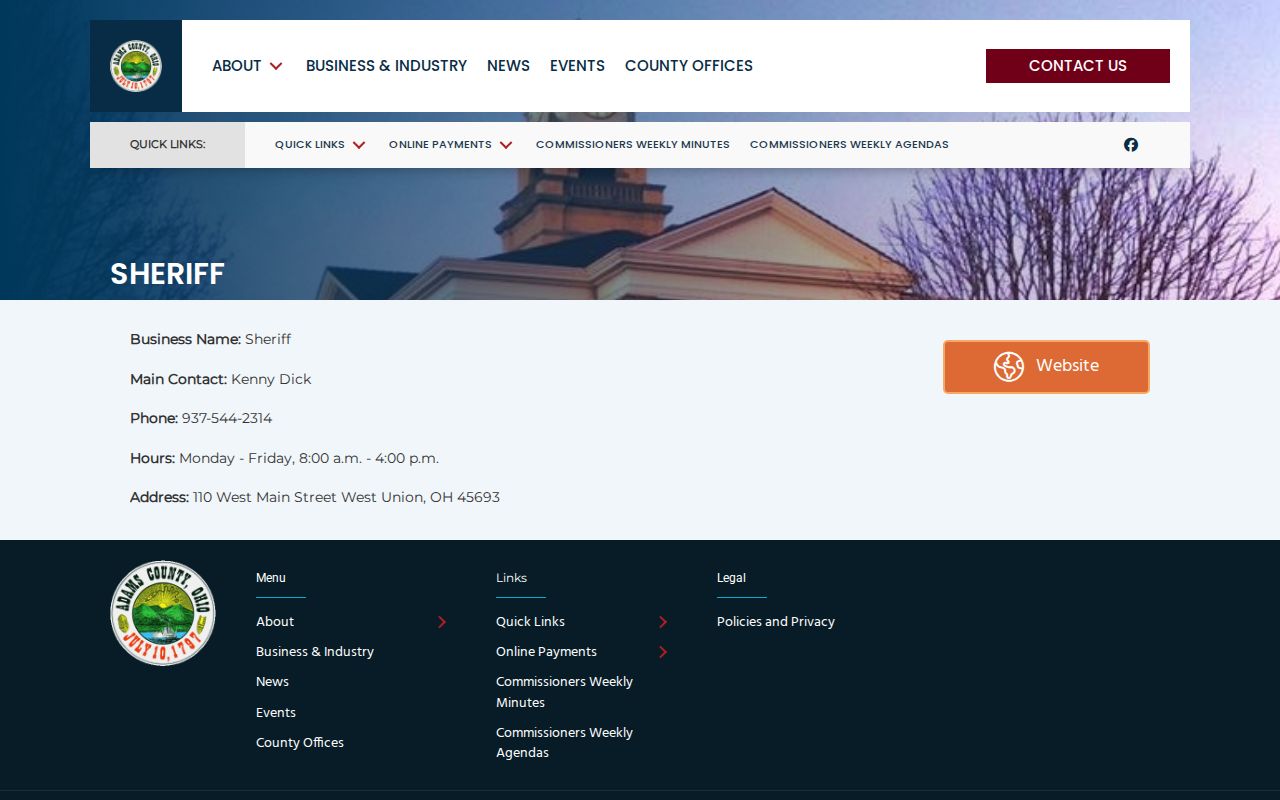
The image documents contact routing only. It does not show release names, fields, cadence, or retention, and it should never be presented as a release list.
Trace Adams Releases Across Systems
A county release record and a state corrections record cover different custody. If the Sheriff reports transfer to ODRC, search the Ohio Department of Rehabilitation and Correction by name, offender number, or county of commitment. A later ODRC record may show Released, APA Supervision, release detail, or judicial release. ODRC does not cover every local jail booking.
Ohio VINELink can provide custody-event awareness when the reporting agency participates and supplies timely data. An absent result is not release proof. Record the live status and reporting agency, then corroborate it with the Sheriff or ODRC. Federal and immigration custody require BOP, USMS, or ICE sources after a documented transfer.
- Community release
- The named custodian ends custody and the person enters the community, possibly under court or state controls.
- Transfer
- One custodian hands the person to another agency; custody continues.
- Detainer
- A request or hold that may direct the person to another authority when local custody ends.
- Community control
- Court supervision in the community, distinct from state parole or post-release control.
Describe Adams Release Results Precisely
Use “booked” only for receipt into custody, “bond set” only for a court's condition, and “bond posted” for the action that may start release processing. Use “released” when the custodian ended custody and “transferred” when another agency received the person. If the source offers no reason, say the person is no longer shown and confirmation is pending.
Keep enough identity data to distinguish the record, but do not combine people merely because their names match. Compare birth date, case number, booking or admission date, committing county, and official identifier as needed. A photo may help distinguish records but cannot prove disposition or release.
Note: The three-day method widens the time range; it does not expand the legal scope or accuracy of any source.
Reconcile Adams Three-Day Records
The Sheriff's record answers when and how county custody ended. The Adams County docket answers what the judge ordered. Start at the court-search selector, choose Common Pleas for a felony or County Court for a misdemeanor or traffic matter, and search one criterion at a time. Review bond activity, judgment entries, sentencing terms, dismissals, jail-time credit, and community-control entries.
Online CaseLook data can trail the filed record by at least a day. That delay matters when a 72-hour range ends near the present time. A Sheriff's Saturday exit and a court entry posted Monday can both be accurate. Compare the event date, filing date, and source timestamp rather than forcing every update into the same order. For verified court information, request or inspect the actual entry through the Clerk.
The Sheriff request should also state whether multiple bookings are in scope. A person may have more than one custody episode, and an older booking photo or case number can lead to the wrong exit. Keep each booking number, case number, and event time paired as a separate record.
Preserve Adams Release Evidence
Write down the office contacted, date and time, precise question, and the exact words used for the event. If a phone answer is urgent, follow it with a records request when the release type, destination, or legal authority matters. A written request gives the custodian a defined interval and allows an explanation if a field does not exist or cannot be released.
Ask for the responsive record in an available format rather than demanding a custom three-day report. Ohio public-record law generally does not require an office to create a new record that it does not keep. The Sheriff may respond with booking records, release logs, transfer documentation, or another existing record instead of a polished 72-hour list.
When two sources conflict, do not average them. Check whether one describes a court order, another describes physical release, and a third describes the next custodian. A VINE timestamp may reflect the source feed, while the Sheriff's underlying event time answers the county-jail question.
Retain the exact response language. “No longer here” is less precise than a record stating community release, transfer, or another disposition. If the office cannot identify the event, report that confirmation remains pending and continue with the agency that may have received custody.
Public Record Search
Sponsored Results